




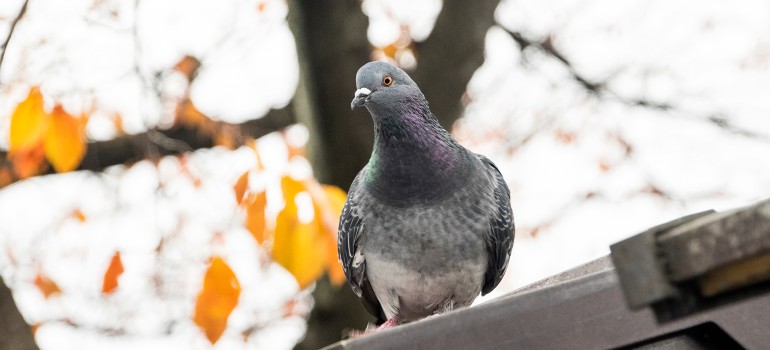
Knowing how to get rid of pigeons without hurting them is more useful than most people realise. Despite their harmless look, pigeons carry diseases, leave behind acidic waste, and bully other birds. You can find them roosting in just about every open spot in your garden, on your roof, or on your balcony. They can also cause a lot of mess and expensive roof damage.
Furthermore, their faeces can pose a threat to your health and invite vermin, such as flies and rats, leading to yet another problem. The noise, health concerns, and structural damage that pigeons can cause should not be left unresolved.
In this article, we cover how to get rid of pigeons in a humane way — including specific advice for balconies, roofs, and gardens, plus what to do if pigeons keep coming back.
Ready to find out how?
TL;DR
- The most effective humane methods for deterring pigeons are physical barriers: netting for enclosed spaces and balconies, spikes for ledges and roof ridges, and chimney caps for chimney pots.
- Secondary deterrents — reflective tape, predator-eye balloons, ultrasonic devices, and gel — can help but work best alongside physical exclusion, not instead of it.
- Under the Wildlife & Countryside Act 1981, it is illegal to harm pigeons, damage their eggs, or disturb an active nest. You must wait until a nest is no longer in use before removing it.
- Pigeon droppings can spread a range of diseases, including Histoplasmosis, Cryptococcosis, and Salmonellosis, and pigeons can carry ectoparasites such as bird mites and bed bugs.
- If pigeons have already established a nest, call a professional before acting — disturbing an active nest may breach the law.
Table of Contents
How to get rid of pigeons humanely
There are six reliable methods for getting rid of pigeons without hurting them: bird netting, anti-bird spikes, wind chimes, repellent gel, reflective surfaces, and ultrasonic devices. Physical barriers are the most consistently effective. Everything else works better as a supporting measure than a standalone fix.
The calls of pigeons can be extremely loud, particularly during their mating season. No matter where pigeons nest — on a roof, window sills, balconies, solar panels, or elsewhere — there are plenty of methods to discourage them from hanging out there.
Pigeon gel, bird nets, spike strips, and ultrasonic devices can all be used as humane bird control options. That being said, our experts in pigeon control recommend several ways to keep them away without hurting them, starting with…
Netting
The use of bird netting is a good option, particularly for balconies and areas that are hard to reach. Whether you have a large-scale problem or just a few occasional incidents, a bird netting system is an effective way of preventing them from nesting on high roofs.
The bird net is strong and will be just as effective against seagulls and other types of larger birds. Moreover, the synthetic cords can withstand harsh weather conditions, such as rain, snow, and heat.
Netting is also worth considering in the garden — stretched over fruit cages, vegetable plots, and raised beds, it physically stops pigeons from getting to plants without disturbing anything else. If you select the correct mesh size, properly installed netting will not trap or harm smaller birds, making it a practical choice when you want to deter pigeons but not other garden birds.
Bird spikes
Stainless steel or plastic anti-bird spikes can be mounted horizontally to prevent birds from landing comfortably. In addition, they do not cause pain or harm to pigeons — they are merely a simple way to keep birds from building nests.
This method is very effective in the battle against pigeons, and despite the appearance of the bird spikes, it’s entirely harmless. Basically, once the spikes are correctly positioned, the birds will not have enough room to build a nest.
The primary installation sites are roof ridges, fence tops, and window ledges — the exact spots pigeons prefer for roosting. Bear in mind that spikes are not well suited to flat, wide surfaces such as chimney tops or broad parapet ledges. On those surfaces, netting or gel is a better choice.
Wind chime
Attaching a wind chime to the roof of your deck or balcony can discourage pigeons from nesting there. These chimes often have reflective objects on them, which prevent pigeons from landing there. The bad part is that, in time, birds can get used to it. To prevent a pigeon infestation, choose strategic locations, such as window sills and ledges, to discourage pigeons.
Think of wind chimes as a secondary layer, not the main line of defence. They work better alongside reflective surfaces than on their own. And if your balcony adjoins a neighbour’s, bear in mind that chimes in an enclosed space can carry sound further than you’d expect.
Bird repellent gel
Bird-repellent gel is exactly as it sounds — a sticky, transparent substance. It is usually applied on ledges or other areas where pigeons are not welcome. Gels often include active components, such as essential oils, which the pigeons find odious.
That being said, they are a short-term solution, as the gel quickly dries or is covered by dust or debris, making it ineffective and needing a re-application. It is also possible for small birds, such as sparrows, to get stuck in the gel.
Use reflective surfaces
This is a tried and tested method for keeping birds away from your garden. The classic version is old CDs strung up to catch the light — but purpose-made reflective tape or ribbon, widely available at UK garden centres, works better and lasts longer. Predator-eye balloons with reflective markings are another option that adds movement alongside the light. The reflective surfaces temporarily affect the pigeons’ eyesight and make them stay away from your deck or balcony.
Ultrasonic bird repeller
Another harmless option is the ultrasonic device. This is a scanning technology that can identify birds from a distance and use sound waves to drive them away. The device comes in several modes that can be customised according to the season.
Ultrasonic systems can reduce roosting activity and are useful in areas where noise-based methods are not an option. That said, pigeons can habituate to ultrasonic sound over time, just as they do to other sensory deterrents. They work best as part of a combined approach rather than as a standalone solution. A solar-powered model keeps running without ongoing effort, which helps maintain the effect for longer.
Important! Follow the law when deterring pigeons: According to the Wildlife & Countryside Act from 1981, you can’t harm pigeons, their nests (while they’re occupied), nor their eggs. Make sure you check local laws concerning the area and which control methods are allowed before you take any action. The Act also protects active pigeon nests — if a nest is already established, you must wait until it is no longer in use before removing it.
Check also: How to Pest Proof Your House
How to deter pigeons from your balcony
Balconies are genuinely attractive to pigeons. They offer a flat surface, overhead shelter, warmth from the building, and — in urban areas — regular proximity to food. Once a pigeon has roosted or nested on your balcony, it will keep coming back. That’s not stubbornness. It’s memory. Pigeons have strong site fidelity and will return to any location where they’ve previously found shelter or food, sometimes for years.
Visual deterrents alone are rarely enough in an enclosed balcony space. The area is simply too small and familiar to the bird for a bit of reflective tape to shift it permanently.
The approach that actually works combines three things. First, netting — fitted across the open face of the balcony, this is the most reliable way to physically exclude pigeons. Second, spikes on the railings and any ledges or sills they land on. Third, gel applied to the remaining flat surfaces. Together, these remove every comfortable landing option without harming the birds.
The other essential step is removing what attracted them in the first place. If you’ve ever left food out, fed them deliberately, or had open waste nearby, that association is what keeps them returning. Stop the food source and block the roost at the same time — doing one without the other rarely holds.
Check also: What Animals Are Pests in the UK?
How to keep pigeons off your roof
Pigeons on a roof cause more damage than most homeowners realise. Their droppings are acidic enough to erode roofing materials over time, and if they find a gap in the soffits or fascia, they’ll work their way inside.
Ridge spikes are the first thing to install. Roof ridges are the most common roosting point because they give pigeons a clear view in all directions. Spikes make that surface unusable without blocking airflow or affecting the structure.
For chimneys, mesh stainless steel caps are the right solution — see the chimney caps section below for the detail on that. What’s worth adding here is that anti-roosting wire systems, also called spring wire or tensioned wire systems, are widely used by professional pest controllers on UK roofs. A tensioned wire is fixed just above the ridge or parapet at a height that prevents birds from landing without causing them any harm. It’s less visible than spikes and effective on longer roof runs.
Sealing soffits and fascia gaps is equally important. A pigeon that can’t roost on the roof will look for a way inside, and small gaps in the eaves are an easy entry point. Check them annually and fill any openings with wire mesh before birds investigate them.
Check also: Preventing Birds from Nesting in Your Soffit
How to deter pigeons from your garden (without affecting other birds)
The wood pigeon (Columba palumbus) is the species most people encounter in UK gardens — bigger and bolder than the feral pigeon, and just as persistent. Stopping pigeons in the garden without affecting robins, sparrows, and other smaller birds is a common problem, and it has a practical solution.
The most effective single change you can make is switching to a weight-sensitive or cage-style bird feeder. These are designed so that larger, heavier birds like pigeons trigger a mechanism that closes the feeding port or are physically excluded by the cage bars, while smaller species pass through freely. If you want to feed blackbirds but not pigeons, this is the right tool — open ground feeding or standard platform feeders will always attract pigeons regardless of what you put in them.
Beyond feeders, the approach for garden pigeon control is targeted rather than blanket:
- Use reflective tape around planted beds and fruit cages rather than across the whole garden — this disrupts pigeons in the areas they’re damaging without affecting open lawn space where smaller birds feed.
- Never put bread or grain directly on the ground. It almost exclusively attracts pigeons and gulls rather than the birds most people want to encourage.
- Clear fallen fruit from trees promptly. A single windfall apple will bring pigeons in and keep them returning.
- Use netting over vegetable plots and soft fruit — this is the most reliable protection for the plants themselves.
The key point is that spikes and netting should go only on the surfaces pigeons actually use — ledges, fence tops, and roof lines — not across open garden areas, which would make the space unwelcoming to all birds, not just pigeons.
How to keep pigeons away
In order to keep your family and yourself safe from various diseases, you should prevent pigeons from getting close to your property. Below are some steps you can take to prevent a pigeon infestation:
Seal off your attic
You should fill gaps between the roof shingles and your house siding. Seal any nesting sites using hardware cloth and silicone caulk or just plastic bird netting. By trimming tree branches that grow close to your roof, you can further prevent access to your attic.
Check also: How to Tell What Kind of Animal is in Your Attic
Use chimney caps
Chimneys are a favourite place for pigeons to chill. Mesh stainless steel caps prevent birds and other animals from entering while still allowing smoke to escape. You should call an expert if you are not comfortable with scaling roofs. Ensure that the chimney isn’t inhabited by pigeons while being capped.
Eliminate food sources
Keep all bird feeders off your property, and never feed the pigeons. A pigeon’s memory of food sources is excellent. Whenever they find human accomplices, they’ll constantly return to those places. In order to eliminate their presence, you need to remove access to food. This includes clearing up fallen fruit from trees and securing compost bins, as both attract pigeons to gardens.
Check also: How to feed birds without attracting rats
Do pigeons carry diseases?
While pigeons are not harmful in the traditional sense, meaning that they don’t attack people, bird droppings can lead to the spread of airborne diseases. A range of diseases can be transmitted by bird fouling, some of which affect humans and pets. Histoplasmosis, Cryptococcosis, and Salmonellosis are among the most common. The UK Health Security Agency advises that pigeon droppings should be treated as a potential health hazard and cleaned up using appropriate protective equipment.
Aside from diseases, pigeons can also carry more than 50 types of ectoparasites, many of which are very harmful. Examples include bird mites, bed bugs, and insects such as mealworm beetles that colonise pigeon nesting sites.
Check also: Do Pigeons Really Carry Diseases?
Hire bird control professionals to help you!
Pigeons are very adaptable creatures. They are fearless when it comes to humans and can be extremely difficult to find a solution for. As a result, it is best to use multiple pigeon control methods in order to keep them at bay. Most of the options require some experience and knowledge for their execution, so consider opting for a professional bird control service for the most efficient results. This is especially advisable if pigeons have already established a nest, as disturbing an active nest may breach the Wildlife & Countryside Act 1981 — a professional can advise on the legal timing of any removal.
Fantastic Pest Control offers professional solutions that can help you rid your property of nasty intruders fast. The service is very affordable, easy to organise, humane, and, most importantly — effective. Make your appointment today!
Are you dealing with a pest infestation?
You don't have to be alone in the battle against pests. Hire a professional pest expert!
Call usFrequently Asked Questions
Are pigeon nests protected by law in the UK?
Yes. Under the Wildlife & Countryside Act 1981, it is illegal to intentionally damage or destroy an active pigeon nest containing eggs or young. You must wait until the nest is no longer in use before removing it. Removing an empty, inactive nest is legal. If you’re unsure whether a nest is still active, a professional pest controller can assess it and advise on the legal timing of removal.
How do I get rid of pigeons but not other birds?
Use weight-sensitive or cage-style bird feeders that physically exclude larger birds like pigeons while allowing smaller species through freely. For the garden and roof, install spikes and netting only on the surfaces pigeons actually prefer — ledges, roof ridges, fence tops, and railings — rather than across open areas that smaller birds use. Targeted placement is the key: you’re making specific roosting spots inhospitable to pigeons, not the whole outdoor space.
Why do pigeons keep coming back to the same spot?
Pigeons have strong site fidelity. They return to locations where they have previously nested or found food, and this memory can persist for a long time. Simply scaring them away temporarily is rarely sufficient — they’ll be back within days. To break the cycle, you need to physically block the roosting site and remove all food sources at the same time. One without the other usually isn’t enough.
What scares pigeons the most?
Physical exclusion — netting and spikes — is more effective than any sound or visual deterrent. Of the non-physical options, sudden movement combined with reflected light tends to work best in the short term. Purpose-made reflective tape moving in a breeze is more effective than static shiny objects. The honest caveat: pigeons habituate to all sensory deterrents within weeks, so rotation and combination matter more than the specific product you choose.


I need the best solution to detect the pigeons’ birds in our huge warehouses
Preventing birds can be done by fixing nets. There are bird nets available and these can prevent the birds and rodents coming inside and building nests. These nets have holes which does allow air flow and light so no issues with that.